What the Industry Won't Tell You
Utah Native Landscapes is an ecological design company. Not a landscaping company with an eco add-on. Here is what that distinction means and what it requires.
April 1, 2026
Most landscaping companies in Salt Lake City now have an "eco-friendly" option. A native plant package. A water-wise tier. A pollinator garden add-on that sits below the standard Kentucky bluegrass package on the same price sheet.
That is not what we do.
Utah Native Landscapes is an ecological design company. We build functioning native habitat. Native plants. Living soil. No synthetic chemicals, no landscape fabric, no rock-only installations, no artificial turf. These are not options we decline — they are practices we exist to replace.
A native landscape is not a garden with better plants. It is a plant community — a designed ecosystem with structural diversity across multiple layers: groundcover, grasses, forbs, shrubs, trees. Each layer serves a function. Each plant was chosen because it has a role in the ecology of the Wasatch Front at 4,200–5,000 feet.
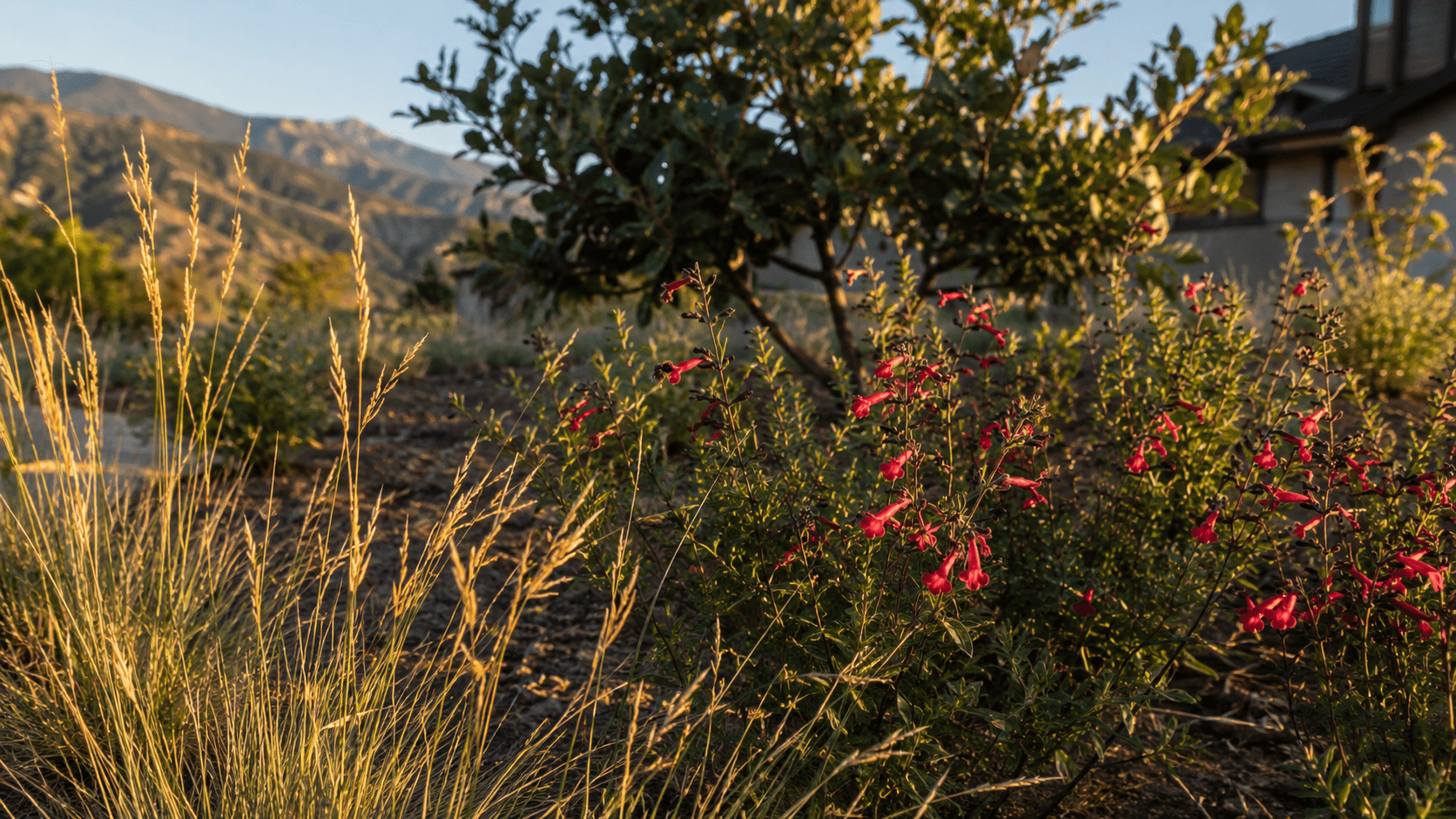
Gambel oak supports 530+ caterpillar species — the primary protein source for nesting songbirds. Penstemon eatonii provides nectar timed precisely to the arrival of black-chinned and broad-tailed hummingbirds. Bouteloua gracilis reduces water use by 70% compared to Kentucky bluegrass and creates the bare-soil pockets that ground-nesting native bees require. See the full plant palette we use across SLC's east side.
Every plant has a reason. Every reason is specific to this place. When we explain a planting decision, we cite the ecology, not the aesthetics. The aesthetics follow. They always do.
The Avenues. Sugar House. Millcreek. 9th & 9th. Federal Heights. East Bench. These are the neighborhoods we serve, and they are the neighborhoods where this work matters most.
SLC's east side sits at the ecotone between foothill sagebrush communities and urban development — one of the higher-diversity native habitats on the Wasatch Front. What gets planted in these neighborhoods has consequence. A Gambel oak on a lot in the Avenues connects to the oak scrub climbing the foothills two miles east. A park strip planted with Eriogonum umbellatum becomes a refueling stop for native bees moving through a neighborhood that is otherwise hostile to them.
This is not a metaphor. Habitat corridors operate at the neighborhood scale. The individual yard is the unit of change.
Landscape fabric is polypropylene — a petroleum-based plastic that degrades into microplastics, severs soil biology, and destroys ground-nesting bee habitat. Jordan Valley Water Conservancy District spent three years removing it from their Conservation Garden Park. We do not install it, and we never will.
Synthetic herbicides, pesticides, and fertilizers work against the mycorrhizal networks, nitrogen-fixing plants, and decomposer communities that make a native landscape self-sustaining. We do not use them.
Rock-only yards save water the same way a parking lot does. Utah's Division of Water Resources calls them "devoid of plants, and therefore habitat." Salt Lake City is already one of the top three urban heat island cities in the country. Rock amplifies that. We do not build it.
These are not preferences. They are the minimum threshold for doing this work honestly.
The clients who call us have already done the research. They know the Great Salt Lake has lost 73% of its water. They know 60% of Salt Lake City's residential water goes to outdoor irrigation. They have read enough about soil biology or native bees or the lawn replacement rebate to know they want something different — and they have spent enough time looking at landscaping company websites to suspect that "eco-friendly options available" is not the same thing.
They are right. It is not.
We work with people who want a yard built on evidence, not marketing language. People who understand that the plants in their front yard are a decision with ecological consequences, and who want to make that decision correctly.
We are not for everyone. We do not need to be.
Every project Utah Native Landscapes designs qualifies for Utah's Landscape Incentive Program — up to $3.00 per square foot, maximum $50,000. The state pays you to replace your lawn with native habitat. We handle the application on your behalf.
For a 2,000 square foot conversion, that is $6,000 returned to you. For a 5,000 square foot front yard, it is $15,000. The rebate does not require a specific contractor — but it does require meeting specific standards. Every design we produce exceeds them.
A site visit is how this starts. Forty-five minutes. We look at sun exposure, soil, drainage, existing plants, and how you use the space. We ask questions. We take notes. We leave with what we need to design a landscape specific to your property — not a template adapted to it.
The design includes every species by common and scientific name, the ecological function each plant serves, the installation sequence, and the water reduction estimate compared to your current landscape.
If that sounds like what you've been looking for, reach out. We have capacity for a limited number of projects per season, and the design process takes time to do correctly.
The Wasatch Front has been waiting a long time for this yard. We are ready to build it.