The Great Salt Lake and Your Yard
Utah pays up to $3.00 per square foot to replace your lawn with water-efficient landscaping — maximum $50,000 per property. Here is exactly how it works, what qualifies, and what doesn't.
May 7, 2026
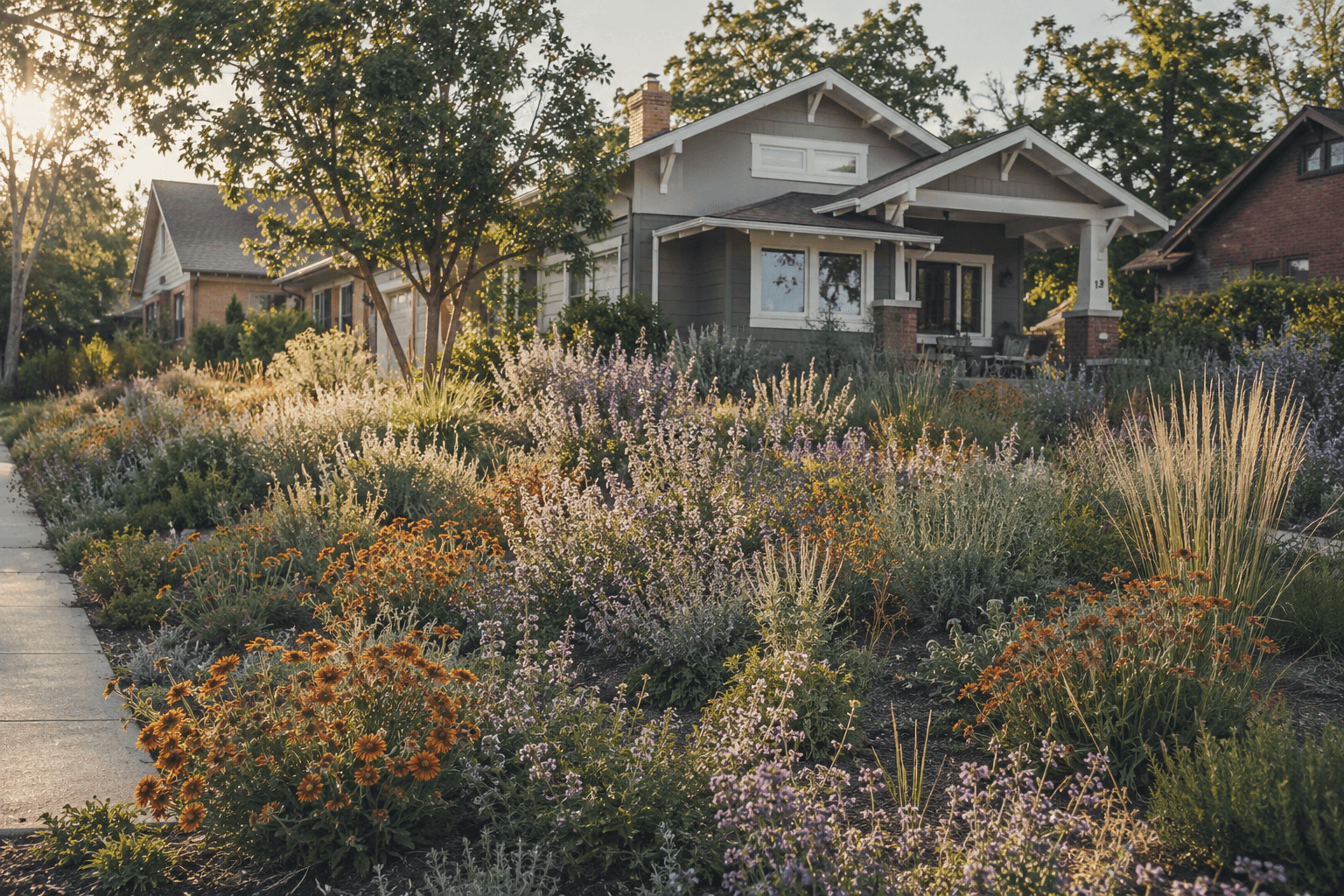
Utah pays homeowners to remove their lawns. The programs have been running for years, they are well-funded, and most SLC east-side homeowners who qualify have not used them.
Here is what is available, what the money actually requires, and what disqualifies a project.
There are two rebate sources relevant to most Salt Lake City east-side homeowners.
Jordan Valley Water Conservancy District is the primary water provider for SLC's east side and operates the most accessible program for this area. Their standard lawn replacement rebate pays up to $3.00 per square foot for converting irrigated turf to qualifying water-efficient landscaping. They also run Flip Your Strip — a separate rebate specifically for park strip conversions, paying $1.25 per square foot. The park strip program has lower documentation requirements and is a good entry point for homeowners who aren't ready to convert the entire front yard.
Utah Division of Water Resources runs the statewide Utah Water Savers program, which pays $1.50–$3.00 per square foot depending on project type and scope. This program operates through participating water conservancy districts and in some cases can be accessed alongside district-level rebates.
For most Avenues, Sugar House, Millcreek, 9th & 9th, Federal Heights, and East Bench properties: JVWCD is your starting point. Verify your water district at your city's utility portal before applying — a small portion of SLC east-side properties are served by Salt Lake City Public Utilities, which has its own separate conservation programs.
A 2,000 square foot front yard conversion at $3.00/sq ft: $6,000 returned.
A 1,500 square foot front yard: $4,500.
A 300 square foot park strip at $1.25/sq ft: $375 — enough to cover a meaningful portion of installation cost on what is typically a small project.
The maximum rebate for a single property through JVWCD is $50,000. For a 5,000 square foot conversion, that is a $15,000 rebate. For a 10,000+ square foot conversion, you hit the cap.
These are not credits applied at the end of a tax year. They are checks issued after your project passes a post-installation inspection. Most homeowners receive payment within 4–8 weeks of final approval.
The programs are designed to reduce outdoor water use. The requirements reflect that goal directly.
Living plant coverage. Your finished landscape must have a minimum of 50% living plant coverage at mature size. This is the defining requirement, and it is why the most common "water-wise" alternatives — rock-only installs, artificial turf — do not qualify. Gravel with a few plants scattered through it does not qualify if the plant coverage at maturity is under 50%.
Drip or subsurface irrigation. Spray irrigation cannot be used on the converted area. Drip emitters or subsurface irrigation serving your plants — not a blanket irrigation zone — is required. A properly installed drip system can also be submitted for separate efficiency rebates through some districts.
Pre-approval. This is the step most people miss. You must apply and receive pre-approval before you remove a single square foot of turf. Taking out your lawn and then applying does not work — the district needs to verify the starting condition. Pre-approval includes a site visit and documentation of your existing irrigated area.
Water-efficient plants. Qualifying plants must be adapted to the region's climate and water availability. Native Intermountain West plants meet this standard by definition. The districts publish approved plant lists; every species Utah Native Landscapes uses is on them. See the full palette we use on SLC's east side.
Artificial turf. Jordan Valley Water Conservancy District, Central Utah Water Conservancy District, and Weber Basin Water Conservancy District all exclude artificial turf from their rebate programs. This is not a technicality — it was a deliberate policy decision based on the material's microplastic shedding, its heat island amplification, and the absence of habitat value. If a landscaping company tells you artificial turf qualifies for rebates in SLC, they are wrong.
Rock-only installations. A yard covered in gravel or decorative rock does not qualify unless living plant coverage at mature size reaches 50%. A yard that is 80% rock and 20% plants fails the threshold.
Landscape fabric under the mulch. JVWCD excludes projects that use landscape fabric, the polypropylene weed barrier sold at hardware stores as "eco-friendly." Their Conservation Garden Park spent three years removing it. The rule exists because fabric destroys soil biology and ground-nesting bee habitat — the same reasons we don't install it.
Non-permitted irrigation changes. If your drip system requires a permit under local building codes (which it often does for larger installations), that permit must be in place. Applications missing irrigation documentation are commonly delayed for this reason.
Reseeded or re-sodded areas. The programs replace irrigated turf with lower-water alternatives. Converting bluegrass to fescue does not qualify.
The steps vary by district, but the general sequence is consistent.
The timeline from pre-approval to final inspection is typically 60–120 days depending on project scope and inspection scheduling. Applying at the start of the season (March–April) gives the most scheduling flexibility.
Missing pre-approval. Starting before approval is the single most common error and results in automatic ineligibility. There is no appeal.
Insufficient plant coverage documentation. The post-installation inspection evaluates coverage at mature size, but the application requires a species list with mature dimensions. If your plant list doesn't demonstrate how 50% coverage will be achieved, the application stalls.
Irrigation not converted. Leaving spray heads active in the converted zone — even if the zone is turned off — is flagged in inspections. The irrigation serving that area must be converted to drip.
Missing receipts. Some districts require proof of material costs as part of the rebate calculation. Keep all purchase documentation from nurseries and suppliers.
Every Utah Native Landscapes project is designed to meet or exceed the rebate program requirements from the first planning conversation. The plant palette is native to the Intermountain West, the irrigation is drip, the coverage calculations are documented, and the application is something we have done before.
We submit the application on your behalf. Pre-approval, post-installation documentation, inspection coordination — that is part of the project, not an add-on.
If you are planning a lawn conversion in the Avenues, Sugar House, Millcreek, 9th & 9th, Federal Heights, or East Bench and want to understand what your specific property would qualify for, start with a site visit. We will confirm your water district, run the rebate calculation for your actual square footage, and tell you exactly what the project would look like.
Your lawn has an exit strategy. The state is paying for it.