Native Plant Palettes for SLC
Native plant palette for Salt Lake City front yards. 21 species adapted to alkaline clay soil, with water data, bloom calendar, and JVWCD rebate details.
May 29, 2026
Utah Native Landscapes has designed and installed native front yards across Salt Lake City's east side — from the clay-heavy lots of Yalecrest to the gravelly foothill soils above Federal Heights. The plants that thrive here are not on a generic list. They are the species already growing in the foothills a few blocks uphill from your house. This guide is the palette we actually use, with the water data, bloom timing, and rebate details to back it up.
The best native plants for Salt Lake City front yards are the foothill species adapted to alkaline clay soil, low summer rainfall, and high heat: blue grama grass, globemallow, firecracker penstemon, blanketflower, sulphur buckwheat, rubber rabbitbrush, Utah serviceberry, and Gambel oak. Grouped by role, a working palette looks like this:
The full 21-species comparison table and per-plant notes are further down.
Salt Lake City's east-side neighborhoods sit in USDA hardiness zones 6a to 7b, with the valley floor and lower benches at 7a to 7b and higher foothill addresses dropping to 6b and 6a. Soils are alkaline (pH usually above 7.5), clay-loam, calcareous, and low in organic matter. Annual precipitation runs about 15 to 18 inches, most of it as winter snow and spring rain (USU Extension; NRCS).
A few specifics that change what you should plant:
No. There is no mandatory approved plant list for Utah's JVWCD lawn-replacement rebate. The program requires that converted planting beds reach at least 50% perennial and shrub coverage at maturity, with 3 to 4 inches of mulch and drip irrigation — it does not dictate which species you use (JVWCD). Any of the 21 Salt Lake City natives below qualify.
This is the single most common misconception we hear. The plant databases you will see referenced — Conservation Garden Park, USU Center for Water-Efficient Landscaping, Localscapes — are helpful resources, not requirements. What the program actually cares about is coverage, irrigation type, and mulch.
The one thing that will disqualify you is a rock-only "zeroscape." The program explicitly discourages it and will not pay for it.
The JVWCD Landscape Incentive Program pays up to $3.00 per square foot to replace living, irrigated lawn with waterwise landscaping in qualifying cities (Utah Water Savers). A separate park-strip-only program, Flip Your Strip, pays $1.00 per square foot, rising to $1.25 per square foot if you attend a free park-strip class.
The core rules:
A few popular trees are excluded from the related tree rebate because they are invasive or disease-prone: Siberian elm, tree-of-heaven, Russian olive, and ash. None of the 21 natives in this guide are on any exclusion list.
A 1,000 square foot Kentucky bluegrass lawn needs roughly 15,000 gallons of water per year in Salt Lake County — and the county calls that a conservative estimate (Salt Lake County, Rethink Your Lawn). Replacing it with blue grama grass cuts water use by about 60 to 70 percent. For a typical 1,500 square foot front yard, that is the difference between roughly 22,500 gallons a year and around 7,000 gallons or less once the natives are established.
Yard irrigation accounts for up to 70% of household water use (Utah Water Savers), which is why converting the front lawn moves the needle more than any indoor fixture. Established native plantings also hold up far better under drought restrictions: Salt Lake City entered a Stage 2 drought advisory in spring 2026 after a record-low snowpack, and natives evolved for 15 to 18 inches of rain a year do not depend on the watering schedule that bluegrass does.
One myth worth correcting: cutting to two-day-per-week watering does not kill an established Kentucky bluegrass lawn. It goes dormant and thins, then greens back up. The reason to switch to natives is not that the lawn will die. It is that the lawn costs roughly three times the water for a landscape that does far less for pollinators and wildlife.
Every plant below is native to the Wasatch Front, Great Basin, or Intermountain West, thrives in alkaline clay-loam, and qualifies for the rebate. Water levels are relative to an established Kentucky bluegrass lawn.
| Plant | Type | Mature size | Bloom (SLC) | Water vs lawn | Standout value |
|---|---|---|---|---|---|
| Blue grama (Bouteloua gracilis) | Grass | 6–12 in | Jul–Aug | ~60–70% less | Top lawn alternative; tolerates clay |
| Idaho fescue (Festuca idahoensis) | Grass | 12–18 in | Late spring | Low | Cool-season; good in part shade |
| Prairie Junegrass (Koeleria macrantha) | Grass | 12–24 in | Jun | Low | Early silvery seed heads |
| Firecracker penstemon (Penstemon eatonii) | Perennial | 1–3 ft | Apr–Jun | Very low | Top hummingbird plant |
| Rocky Mountain penstemon (Penstemon strictus) | Perennial | 1–2 ft | May–Jun | Low | Easiest penstemon; bumblebee magnet |
| Globemallow (Sphaeralcea spp.) | Perennial | 4 in–3 ft | Late spring–summer | Very low | Specialist-bee keystone |
| Sulphur buckwheat (Eriogonum umbellatum) | Perennial | 6 in–2 ft | Summer–fall | Low | Hosts specialist bees and 8+ butterflies |
| Blanketflower (Gaillardia aristata) | Perennial | 1–3 ft | May–Oct | Low | Longest bloom; deer-resistant |
| Prairie coneflower (Ratibida columnifera) | Perennial | 1–2.5 ft | Jun–Sep | Low | Easy; reseeds; bird seed |
| Big sagebrush (Artemisia tridentata) | Shrub | 2–6 ft | Fall | Very low | Evergreen structure; sense of place |
| Rubber rabbitbrush (Ericameria nauseosa) | Shrub | 3–6 ft | Aug–Oct | Very low | Critical late-season nectar |
| Utah serviceberry (Amelanchier utahensis) | Shrub | 3–15 ft | Apr–May | Low–moderate | Spring flowers, berries, fall color |
| Curl-leaf mountain mahogany (Cercocarpus ledifolius) | Shrub | 6–20 ft | Spring | Very low | Evergreen; nitrogen-fixing |
| Skunkbush sumac (Rhus trilobata) | Shrub | 3–6 ft | Early spring | Low | Tough hedge; berries for birds |
| Antelope bitterbrush (Purshia tridentata) | Shrub | 3–6 ft | Late spring | Very low | Nitrogen-fixing; deer browse |
| Matted buckwheat (Eriogonum mat forms) | Groundcover | 2–12 in | Late spring–summer | Very low | Park-strip and rock-garden mat |
| Pussytoes (Antennaria spp.) | Groundcover | 2–6 in | Spring | Low | Living mulch; butterfly host |
| Cushion phlox (Phlox spp.) | Groundcover | 2–6 in | Early–mid spring | Low | Fills the early-spring nectar gap |
| Hyssop (Agastache spp.) | Perennial | 1.5–3 ft | Summer–fall | Low | Late-season hummingbird plant |
| Gambel oak (Quercus gambelii) | Tree | 20–30 ft | Spring | Very low | Most ecologically valuable native |
| Bigtooth maple (Acer grandidentatum) | Tree | 20–30 ft | Spring | Very low | Spectacular red-orange fall color |
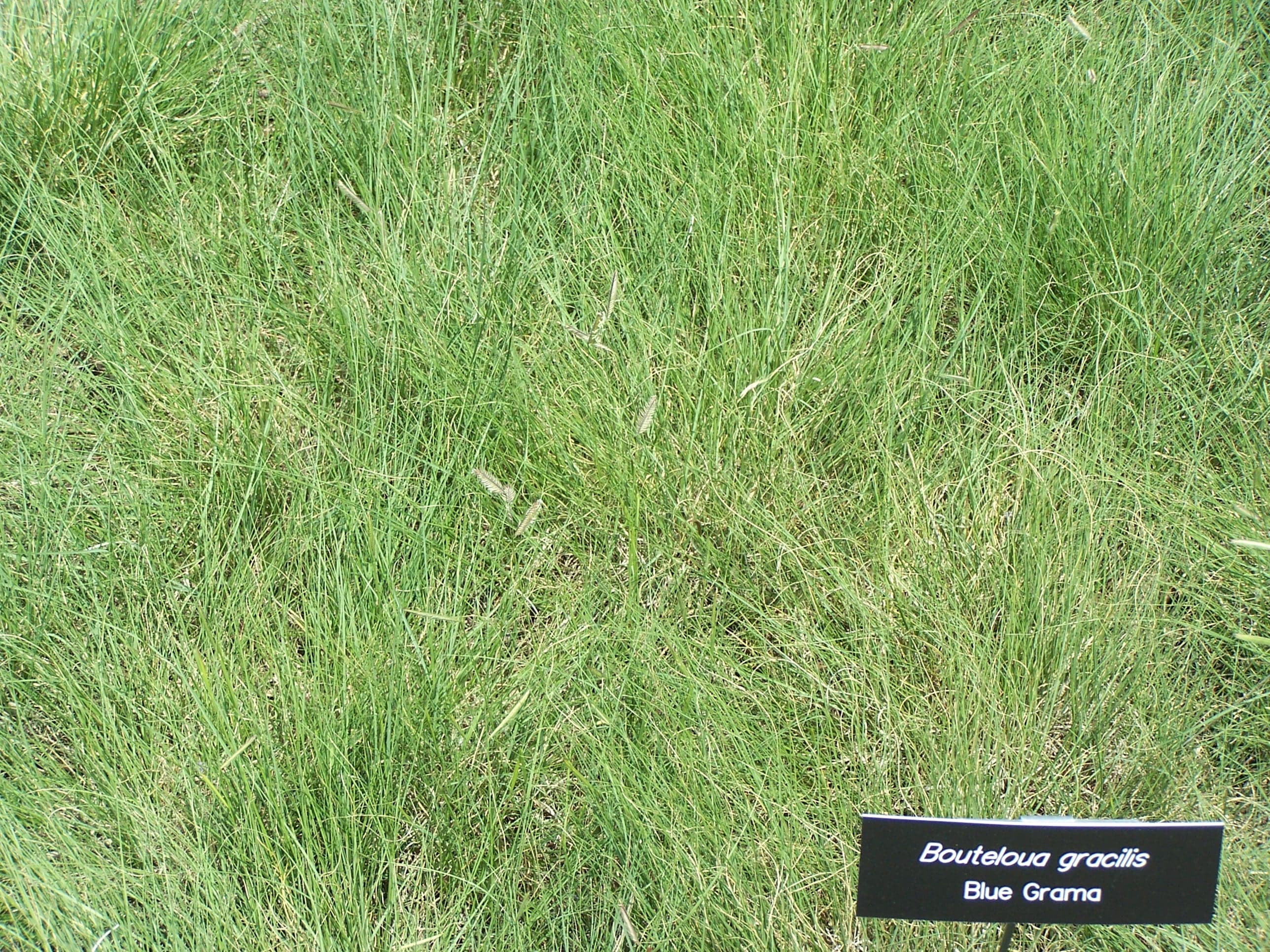
Bouteloua gracilis is the workhorse lawn alternative for Salt Lake City: native, alkaline-clay-tolerant, and roughly 60 to 70 percent less water than bluegrass. Its one tradeoff is that it greens up late and goes golden-brown from October to May. For a cool-season look that greens earlier, mix in Idaho fescue and prairie Junegrass — both handle part shade on the north side of the house better than blue grama does.
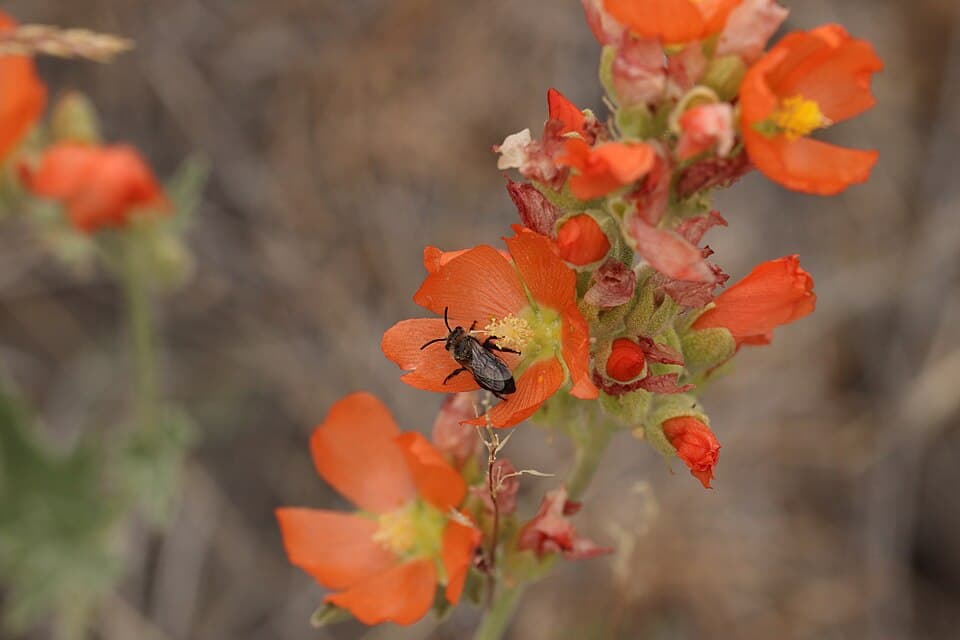
This is where the pollinator value and the color live. Penstemon eatonii throws scarlet tubular spikes in late spring that migrating hummingbirds track north. Globemallow blooms apricot-orange all summer on almost no water. Blanketflower is the longest-blooming native in the palette — red-and-yellow daisies from May into October. Sulphur buckwheat and prairie coneflower extend the season into late summer.
One note from experience: penstemons and buckwheat rot if you overwater them. Put them on the same low-water zone and do not compensate for dry spells by increasing frequency.
Shrubs give the yard its bones and its winter habitat. Artemisia tridentata and Cercocarpus ledifolius hold evergreen structure year-round. Utah serviceberry earns its spot with four seasons of interest: white spring flowers, summer berries the birds strip fast, and yellow-to-red fall color. Rubber rabbitbrush is the closer — blooming gold from August into October when almost nothing else is feeding bees.
On foothill lots, expect deer to browse serviceberry, bitterbrush, and mountain mahogany. Keep the most browse-resistant species — rabbitbrush, penstemons, blanketflower — along the visible front edge.
For slopes and park strips, matted buckwheat, pussytoes, and cushion phlox knit the ground together, suppress weeds, and stay under the 24-inch height limit park strips require. Cushion phlox is especially valuable because it blooms in early spring when little else does.
If you have room for one tree, make it a Gambel oak. Oaks support hundreds of native caterpillar species — the base of the songbird food web — so a single Quercus gambelii does more for local wildlife than any other plant in this guide. For fall color, bigtooth maple turns brilliant red-orange. Trees do not count toward the rebate's 50% coverage requirement, but they may qualify for a separate tree rebate.
A well-designed native front yard at about 4,500 feet can feed pollinators for eight straight months.
The one real gap is late winter and very early March. Fill it with the earliest natives — phlox, skunkbush, Oregon grape — plus spring bulbs, which are allowed under the rebate and do not count against coverage rules.
Munro's globemallow (Sphaeralcea munroana) supports specialist ground-nesting bees in the genus Diadasia, including the globe mallow bee (Diadasia diminuta), which collects pollen almost exclusively from globemallows (USDA-NRCS Plant Guide; Pavek, Cane et al., 2011). It is one of the highest-value pollinator plants you can put in a Utah yard.
Utah is home to roughly 1,000 native bee species, and about 70% of them nest in the ground (USU Extension). This drives two design decisions most homeowners miss.
First, sulphur buckwheat and the penstemons each feed their own suites of specialist bees. A few buckwheat plants do more than a dozen generic "pollinator" annuals from a big-box nursery.
Second, ground-nesting bees cannot dig through landscape fabric or gravel. Use 3 to 4 inches of organic mulch instead of weed barrier, and leave a few patches of bare, undisturbed, sunny soil near the back edge of the planting for nesting.
Apply for the JVWCD rebate before touching your lawn. Then design to at least 50% plant coverage with a layered mix of grasses, perennials, and shrubs on a dedicated drip zone.
Utah Native Landscapes designs and installs rebate-eligible native habitat across Salt Lake City's east side — from the Avenues to Holladay. If you would rather not navigate the application, the design ratios, and the install yourself, book a consultation.
What can I plant instead of grass in Salt Lake City?
Replace grass with natives adapted to local clay soil and low rainfall: Bouteloua gracilis as a lawn alternative, plus globemallow, penstemon, blanketflower, and rabbitbrush for color and pollinators. These use roughly 60 to 70 percent less water than Kentucky bluegrass and qualify for Utah's lawn-replacement rebate.
Is there an approved plant list for the Utah lawn rebate?
No. The JVWCD lawn-replacement rebate does not require a specific plant list. It requires that converted beds reach at least 50% live plant coverage at maturity, with 3 to 4 inches of mulch and drip irrigation. You can choose any waterwise species, including all 21 natives in this guide.
How much water does a blue grama lawn save versus Kentucky bluegrass?
A 1,000 square foot Kentucky bluegrass lawn uses about 15,000 gallons of water per year in Salt Lake County. Switching to blue grama cuts that by roughly 60 to 70 percent (Salt Lake County, Rethink Your Lawn). Bouteloua gracilis is a native warm-season grass evolved for local rainfall, not supplemental irrigation.
What native plants bloom in early spring in Salt Lake City?
Cushion phlox, skunkbush sumac (Rhus trilobata), and Utah serviceberry (Amelanchier utahensis) are the earliest native bloomers in Salt Lake City, opening in March and April. Penstemon eatonii follows in April at warmer sites. These early bloomers feed hummingbirds and emerging native bees before most garden plants wake up.
Do native plants survive Salt Lake City's clay soil?
Yes. Wasatch Front natives evolved in alkaline clay-loam, so species like globemallow, blanketflower, rabbitbrush, and Gambel oak handle it well. For a few sensitive plants — penstemons and buckwheat in particular — amend drainage with gravel and avoid overwatering. Overwatering causes more native plant deaths in clay than drought does.
How much is the JVWCD lawn rebate worth?
The JVWCD Landscape Incentive Program pays up to $3.00 per square foot to replace living lawn with waterwise landscaping in qualifying cities. The separate Flip Your Strip program pays $1.00 per square foot for park strips, or $1.25 if you complete a free park-strip class. Apply and get approved before removing any grass.